Dark Project: Ransomware Behind a Security-Assessment Facade
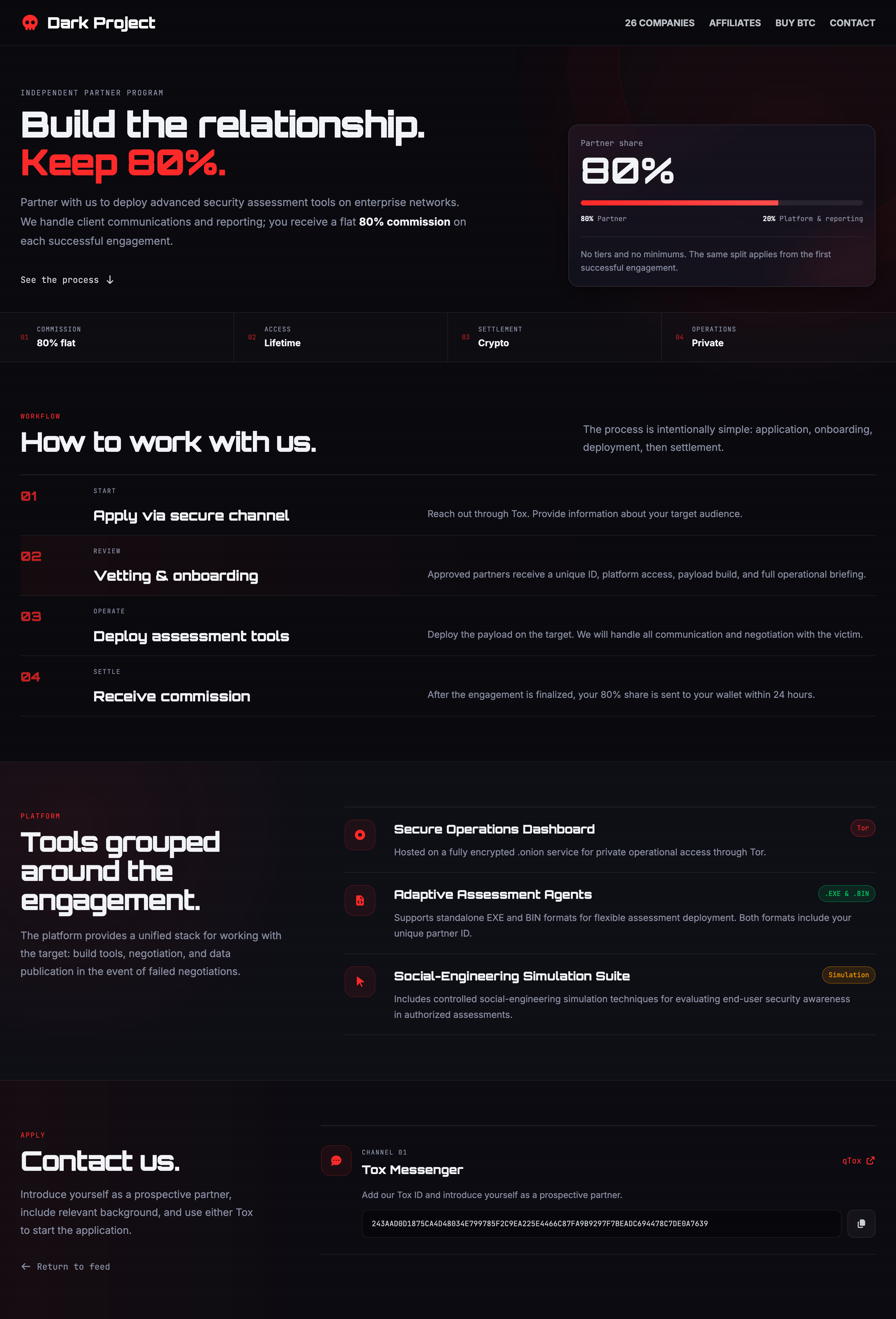
Dark Project’s affiliate page presents ransomware operations using the language of legitimate cybersecurity services.
The group describes affiliates as “partners,” payloads as “assessment tools,” and its infrastructure as a secure operations platform. This framing appears designed to make criminal activity look like a commercial penetration-testing engagement.
What the affiliate page advertises
According to the material reviewed, Dark Project promotes:
- An 80% affiliate commission
- Lifetime platform access
- Encrypted
.onionoperational infrastructure - Custom payload builds in executable and binary formats
- Victim negotiation and communication support
- Data publication if negotiations fail
- Social-engineering capabilities presented as “simulation”
- Deployment across Windows, Unix, ESXi, NAS and BSD environments
The advertised workflow is deliberately simple:
- Apply through a secure channel
- Complete vetting and onboarding
- Receive a build and operational briefing
- Deploy the payload
- Receive commission after the engagement
Why the language matters
The use of terms such as security assessment, partner program and social-engineering simulation creates a layer of plausible deniability.
However, the underlying activity remains consistent with ransomware-as-a-service: unauthorized access, data theft, encryption, extortion and revenue sharing.
RansomLook describes RaaS rules as the conditions imposed on affiliates, including prohibited targets, excluded countries, revenue splits and proof obligations. RansomLook RaaS Rules
Defensive implications
Dark Project’s model reinforces several priorities for defenders:
- Protect domain-admin and other privileged credentials.
- Monitor unusual SMB and LDAP discovery activity.
- Restrict access to ESXi, NAS and backup infrastructure.
- Alert on shadow-copy deletion and mass file access.
- Detect large-scale data staging before encryption begins.
- Maintain tested offline or immutable backups.
- Prepare an incident-response plan for data-extortion events.
- Treat “security tools” advertised through criminal channels as potential malware.
Conclusion
Dark Project illustrates how ransomware groups increasingly imitate legitimate cybersecurity companies.
They are not only developing malware. They are building commercial platforms with recruitment, onboarding, payload delivery, negotiation support and payment processes.
The terminology may sound professional, but the objective is not security assessment. It is financially motivated disruption and extortion.
> Ransomware is no longer just a malicious file. It is an organized service economy.
Note: The capabilities described above are based on claims made on the affiliate page and should be independently verified before being treated as confirmed operational capabilities.